
Before I start earning microcredentials, I would like to develop a list of criteria that I already find crucial with regard to an evaluation framework.
First, the publication, What Is Competency-Based Education? An Updated Definition sheds light on the current expectations for competency-based learning (Levine et al., 2019). Based on the definition, microcredentials should include:
“Students are empowered daily to make important decisions about their learning experiences, how they will create and apply knowledge, and how they will demonstrate their learning.
Note: (Levine et al., 2019, p. 3) Content in this report is licensed under a Creative Commons Attribution 4.0 International license.
Assessment is a meaningful, positive, and empowering learning experience for students that yields timely, relevant, and actionable evidence.
Students receive timely, differentiated support based on their individual learning needs.
Students progress based on evidence of mastery, not seat time.
Students learn actively using different pathways and varied pacing.
Strategies to ensure equity for all students are embedded in the culture, structure, and pedagogy of schools and education systems.
Rigorous, common expectations for learning (knowledge, skills, and dispositions) are explicit, transparent, measurable, and transferable.”
I have emphasized the parts of the definition which I believe would be important to consider in an evaluation framework.
Another Aurora Institute publication, Designing for Equity: Leveraging Competency-Based Education to Ensure All Students Succeed, summarizes the authors’ idea of successful digital learning (Sturgis et al., 2019, p.42) by stating,
“If competency education is going to realize its promise, we must take responsibility for ensuring that each and every student benefits by mastering the skills they need to succeed and that each and every student is learning, progressing and on their way to building the competencies required for college and careers.”
Finally, Laurie Gagnon, the CompetencyWorks Program Director at the Aurora Institute, shared a helpful graphic on her recent blog post (Gagnon, 2024), as shown below.
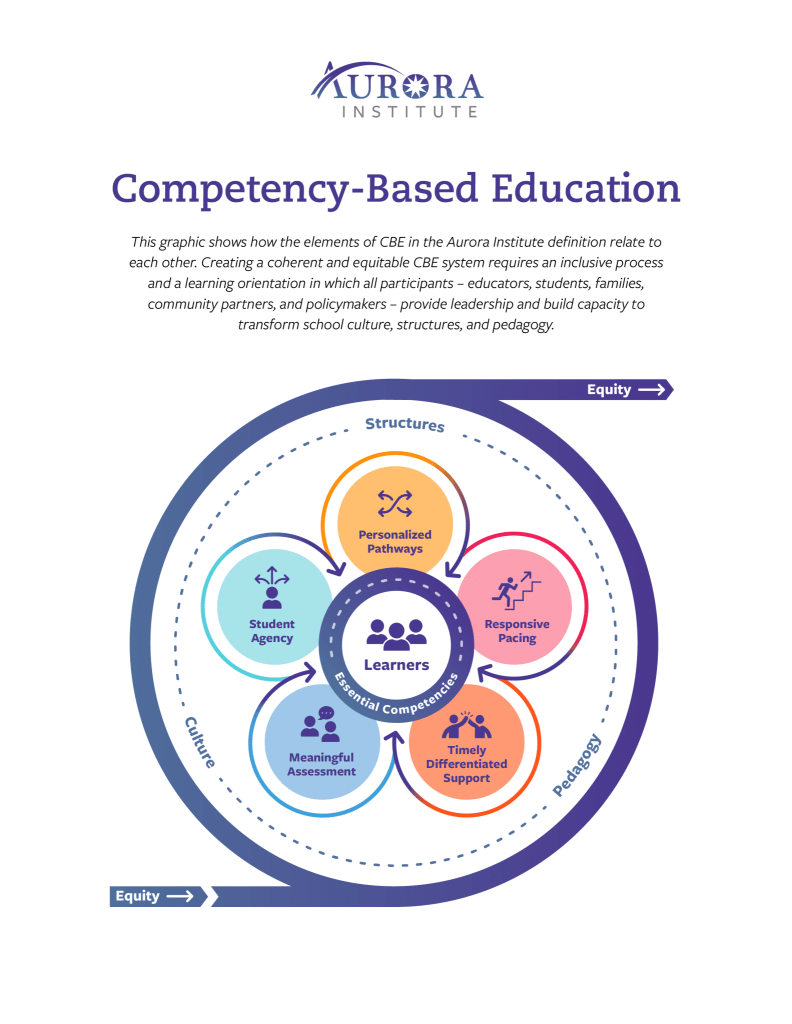
In moving forward to create my own framework for evaluation of microcredentials, these main components, show in the figure, are the perfect foundation (Gagnon, 2024). Also important is that the components in the image are surrounded by equity, an important part of competencies also emphasized by Sturgis and Casey (Sturgis et al., 2019).
References
Gagnon, L. (2024). Illustrating the Competency-Based Education Definition. Aurora Institute. https://aurora-institute.org/cw_post/illustrating-the-competency-based-education-definition/
Levine, E., Patrick, S., Aurora Institute, Technical Advisory Group on Developing a Working Definition of Competency-Based Education, & CompetencyWorks. (2019). What is Competency-Based Education? An updated definition. In Aurora Institute, American Youth Policy Forum, Jobs for the Future, National Governors Association, Nellie Mae Education Foundation, Barr Foundation, Bush Foundation, Carnegie Corporation of New York, & Chan Zuckerberg Initiative, Aurora Institute. Aurora Institute. https://aurora-institute.org/wp-content/uploads/what-is-competency-based-education-an-updated-definition-web.pdf
Sturgis, C. and Casey, K. (2018) Designing for Equity: Leveraging Competency-Based Education to Ensure All Students Succeed. In Aurora Institute, American Youth Policy Forum, Jobs for the Future, National Governors Association, Nellie Mae Education Foundation, Barr Foundation, Bush Foundation, Carnegie Corporation of New York, & Chan Zuckerberg Initiative, Aurora Institute. Aurora Institute. https://aurora-institute.org/wp-content/uploads/CompetencyWorks-DesigningForEquity.pdf
 Lorie Bell
Leave a comment