
The first few microcredentials that I earned this Summer were relatively short (under five hours of “seat time,” so to speak), so I wanted to explore some more substantial courses.
In an earlier blog post, I mentioned my frustration with finding free but high-quality microcredentials, so it took longer than I would care to admit to find the Open University website. (I changed my search terms to focus on “free digital badges” instead of microcredentials.) However, it offers a plethora of resources, and I found the course content of each class to be rich, detailed, and well-written and organized.
Eventually, I completed four offerings (three digital badges and a certificate) from this UK-based organization, and I learned a lot in each course. However, my pursuit of one of these microcredentials was my biggest mistake so far in my Summer learning journey. But first, let’s focus on the three courses that were the right “fits” for me.
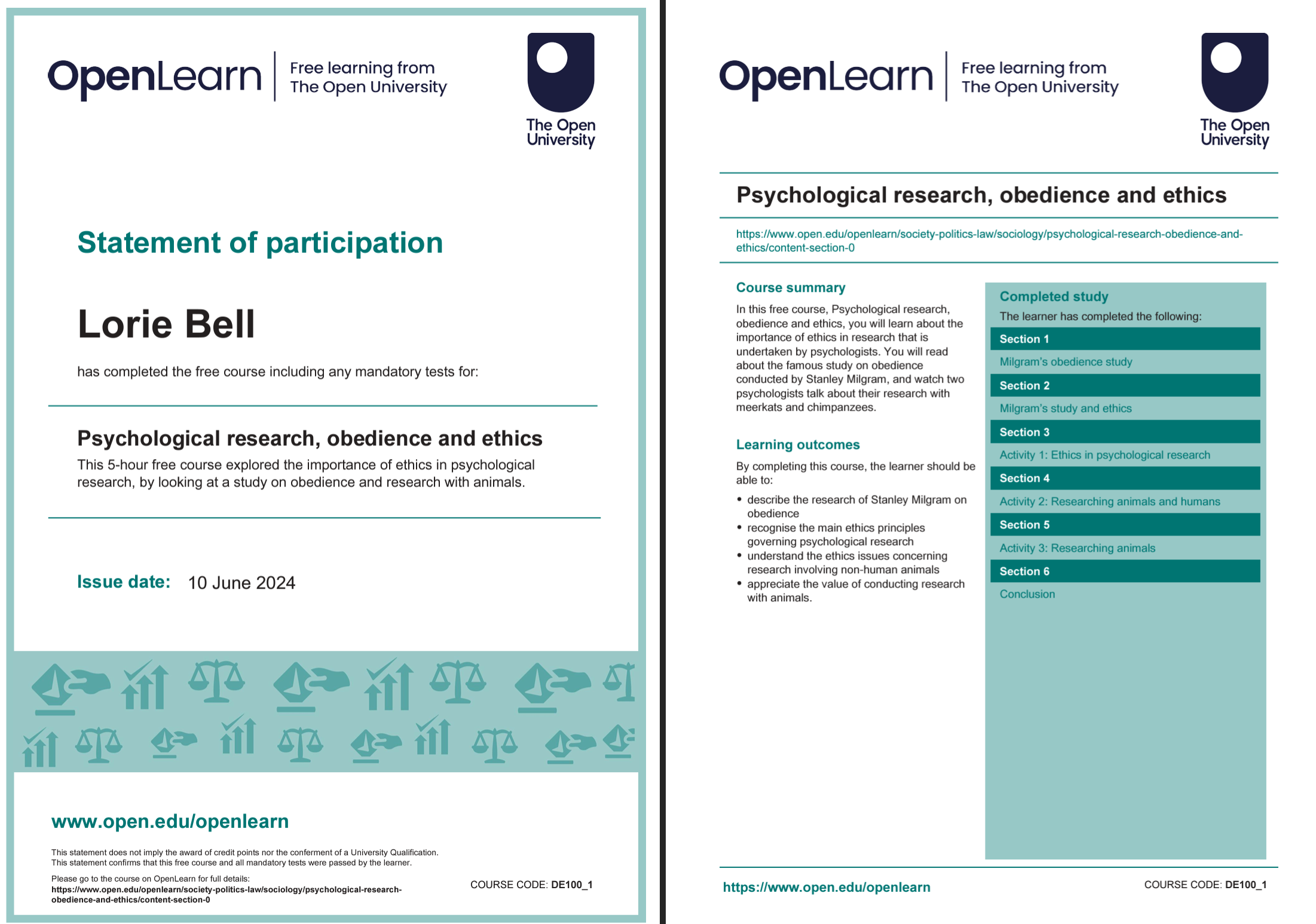
Microcredential – Psychological Research and Ethics
Free, Immediate Cerficate
- Name: Psychological Research, Obedience, and Ethics
- Issuing Organization:
- Description of Learning Outcomes and Competencies:
- Recognize the main ethical principles governing psychological research, such as informed consent, minimizing deception, and avoiding harm to participants.
- Appreciate the scientific value and importance of conducting carefully regulated research with animals to advance knowledge and develop treatments that can benefit both human and animal health.
- Alignment with my professional goals:
- As I am actively learning about research methods in my Appalachian State University doctoral program in instructional technology, I recognize that ethics is at the heart of any research method. I appreciated learning more about research that involves participation from other people.
- Timeline for Completion (estimated):
- Course content is provided, along with optional activities to apply learning along the way.
- Users must pass two major quizzes with at least 50% accuracy in order to be credentialed.
- The Open University estimates that this certificate takes five hours of time to complete. I think the estimate is pretty accurate, although it depends on how much time learners choose to invest in the optional activities or additional resources.
Microcredential – Workplace Diversity & Inclusion
Free, Immediate Digital Bade and Certificate
- Name: Diversity and Inclusion in the Workplace
- Issuing Organization:
- Description of Learning Outcomes and Competencies:
- Introduces the benefits and complexities of developing a diverse and inclusive workforce.
- Explores the positive impact of diversity on staff wellbeing and innovation.
- Provides practical ideas and approaches to recruitment and retention and embedding diversity and inclusivity into workplace culture.
- Opportunities to learn from leaders in this area.
- Alignment with my professional goals:
- Most of my professional experiences have been in workplaces that were desperately liking in diversity among the workforce. As a changemaker, anything that I can learn about inclusion and diversity is helpful to my future endeavors.
- Timeline for Completion (estimated):
- Readings, videos, and optional activities are provided for learners.
- Students must score at least 50% on two major quizzes in order to be credentialed.
- An estimate of 24 hours of work is associated with this course for learners who are novices to the topic.

Microcredential – Teaching Online
Free, Immediate Digital Bade and Certificate
- Name: Take Your Teaching Online
- Issuing Organization:
- Description of Learning Outcomes and Competencies:
- learn about principles of effective, inclusive and accessible online education
- Alignment with my professional goals:
- Emerging technologies have changed the landscape of education and will continue to do so. As an educator, I recognize that the skills to effectively implement technology into instruction are different than a general pedagogical skillset.
- Timeline for Completion (estimated):
- Students engage with text and video content, which is quite thorough.
- Credentialing requires learners to pass two major quizzes with at least 50% accuracy.
- An estimate of 24 hours of work is anticipated to complete this course. However, the actual time investment is probably more dependent on a user’s background in teaching online (novice, intermediate, or veteran). The 24-hour estimate is based on the expected experience of someone who is at the intermediate level with this topic.
Now, the fourth microcredential I earned from the Open University was a lesson for me in overconfidence. The course was labeled for “advanced” users, and, when it comes to systems thinking, I would definitely categorize myself as a novice. Nonetheless, I thought I would be able to handle the content easily.
I was wrong.

The content of this course, while high-quality, very through, and well-organized, was very difficult for me to master. I had to read and reread the content in order to understand it.
If I had to do it again, I would explore their intermediate eight-hour course on systems thinking instead. When it comes to displaying this digital badge, I did the work, but I definitely have “imposter syndrome.”
Microcredential – Systems Thinking
Free, Immediate Digital Badge and Certificate
- Name: Mastering Systems Thinking in Practice
- Issuing Organization:
- Description of Learning Outcomes and Competencies:
- Learn to approach complex and messy situations with a more holistic mindset.
- Understand the roles that others play, considering the interconnectedness of all components within problem situations, and strive to work more collaboratively.
- Alignment with my professional goals:
- Systems thinking helps educational leaders improve teaching quality and raise student achievement in today’s complex educational environment. It’s a comprehensive approach to leadership in education.
- Timeline for Completion (estimated):
- The readings, videos, and optional activities are provided for to help guide learners in this complex content.
- Students must score at least 50% on two major quizzes in order to receive the digital badge.
- An estimate of 24 hours of work is associated with this course for learners who are intermediate in the topic. I estimate that it takes a few hours longer for novices.
All things considered, the learning opportunities provided for free by the Open University are fantastic. One must just trust their descriptions of their intended audiences.
References
The home of free learning from the Open University. (2024). Open Learning. https://www.open.edu/openlearn/
 Lorie Bell
Leave a comment